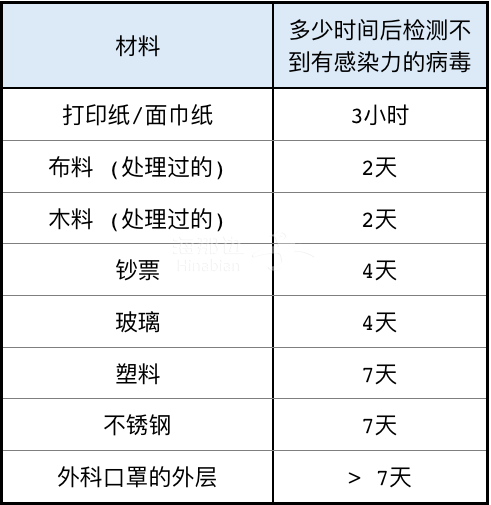
[1] N. van Doremalen et al., Aerosol and Surface Stability of SARS-CoV-2 as Compared with SARS-CoV-1. New England Journal of Medicine, (2020).
[2] A. W. H. Chin et al., Stability of SARS-CoV-2 in different environmental conditions. The Lancet Microbe.
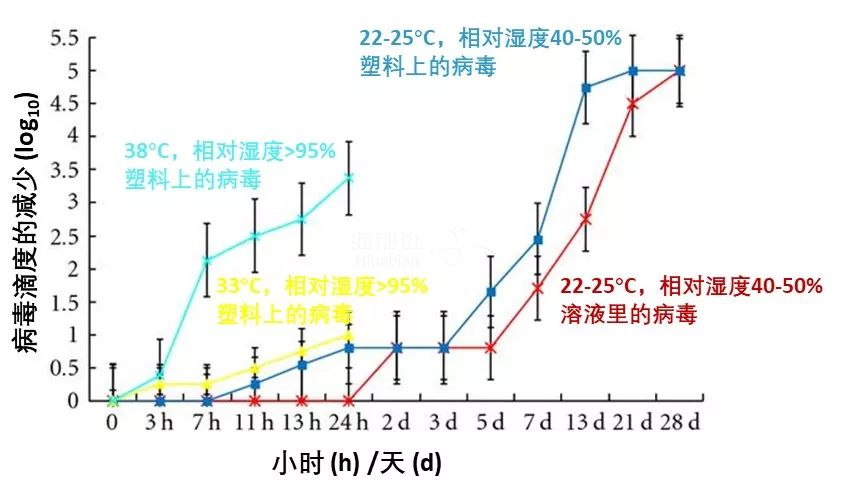
[3] L. M. Casanova, S. Jeon, W. A. Rutala, D. J. Weber, M. D. Sobsey, Effects of air temperature and relative humidity on coronavirus survival on surfaces. Appl Environ Microbiol 76, 2712-2717 (2010).
[4] C.-M. Chu et al., Viral load distribution in SARS outbreak. Emerg Infect Dis 11, 1882-1886 (2005).
[5] I. F. N. Hung et al., Viral loads in clinical specimens and SARS manifestations. Emerg Infect Dis 10, 1550-1557 (2004).
[6] S. C. C. Wong, J. K. C. Chan, K. C. Lee, E. S. F. Lo, D. N. C. Tsang, Development of a quantitative assay for SARS coronavirus and correlation of GAPDH mRNA with SARS coronavirus in clinical specimens. J Clin Pathol 58, 276-280 (2005).
[7] M. P. Zwart et al., An experimental test of the independent action hypothesis in virus–insect pathosystems. Proceedings of the Royal Society B: Biological Sciences 276, 2233-2242 (2009).
[8] K. H. Chan et al., The Effects of Temperature and Relative Humidity on the Viability of the SARS Coronavirus. Adv Virol 2011, 734690 (2011).
[9] L. Casanova, W. A. Rutala, D. J. Weber, M. D. Sobsey, Survival of surrogate coronaviruses in water. Water Research 43, 1893-1898 (2009).
[10] B. J. Tennant, R. M. Gaskell, C. J. Gaskell, Studies on the survival of canine coronavirus under different environmental conditions. Veterinary Microbiology 42, 255-259 (1994).
[11] G. J. Harper, Airborne micro-organisms: survival tests with four viruses. J Hyg (Lond) 59, 479-486 (1961).
[12] A. Lamarre, P. J. Talbot, Effect of pH and temperature on the infectivity of human coronavirus 229E. Canadian Journal of Microbiology 35, 972-974 (1989).
[13] B. D. Zelus, J. H. Schickli, D. M. Blau, S. R. Weiss, K. V. Holmes, Conformational Changes in the Spike Glycoprotein of Murine Coronavirus Are Induced at 37°C either by Soluble Murine CEACAM1 Receptors or by pH 8. Journal of Virology 77, 830-840 (2003)
[14] C. Daniel, P. J. Talbot, Physico-chemical properties of murine hepatitis virus, strain A 59. Brief report. Arch Virol 96, 241-248 (1987).
[15] D. H. Pocock, D. J. Garwes, The influence of pH on the growth and stability of transmissible gastroenteritis virus in vitro. Arch Virol 49, 239-247 (1975).
[16] A. Pratelli, Canine coronavirus inactivation with physical and chemical agents. The Veterinary Journal 177, 71-79 (2008).
[17] M. Y. Y. Lai, P. K. C. Cheng, W. W. L. Lim, Survival of Severe Acute Respiratory Syndrome Coronavirus. Clinical Infectious Diseases 41, e67-e71 (2005).
[18] M. M. Lei Pan, Pengcheng Yang, Yu Sun, Runsheng Wang, Junhong Yan, Pibao Li, Baoguang Hu, Jing Wang, Chao Hu, Yuan Jin, Xun Niu, Rongyu Ping, Yingzhen Du, Tianzhi Li, Guogang Xu, Qinyong Hu, Lei Tu, Clinical characteristics of COVID-19 patients with digestive symptoms in Hubei, China: a descriptive, cross-sectional, multicenter study. The American Journal of Gastroenterology, (2020).
[19] B. Bean et al., Survival of Influenza Viruses on Environmental Surfaces. The Journal of Infectious Diseases 146, 47-51 (1982).